
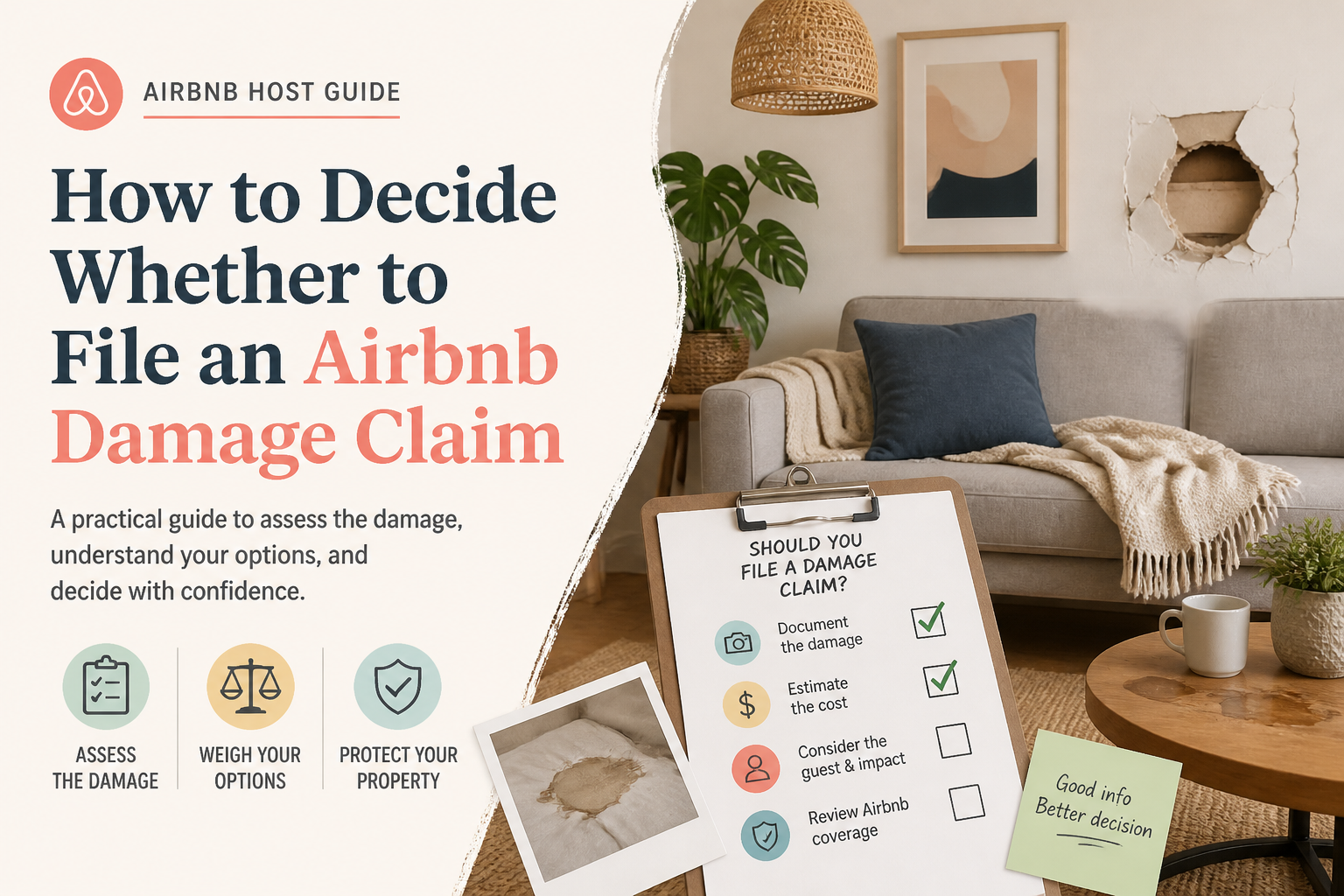
How to Decide Whether to File an Airbnb Damage Claim
A practical way to decide in advance which damage you will absorb and which you will pursue, so you stop agonizing every time something breaks.
Key takeaways
- Set a damage threshold that fits your margins, write it down, and review it annually.
- Build breakage costs into your pricing and keep inexpensive spares of items that commonly break.
- Take dated photos at every turnover and organize them by stay to document property condition.
- When filing a claim, keep communication factual and inside the platform, and check Airbnb’s current claim window.
Something breaks, you find it at turnover, and suddenly you are standing in your own kitchen deciding whether this is worth a fight. The worst time to make that decision is in the moment, when you are tired and annoyed. Hosts who seem calm about damage are almost never calmer people. They simply made the decision earlier, on a quiet day, and now they are following a rule. Here is how to build yours.
Pick a Dollar Threshold Before You Need One
Start with a number. Hosts in a large community discussion described thresholds ranging from absorbing anything under twenty five dollars to filing only above one hundred. A few used flat fees, such as a small set charge for any broken plate or glass, regardless of its real price. There is no correct figure, but there is a wrong way to choose one: while you are looking at the damage.
Consider your nightly rate when you decide. A host earning a modest rate cannot absorb the same loss as one earning several times more, and one host pointed out that a threshold only works if it fits your actual margins. Write your number down, keep it somewhere you will see it, and review it once a year as your business changes.
Build Breakage Into Your Pricing
The easiest way to stop resenting small losses is to stop treating them as surprises. Several hosts set aside a fixed percentage of each booking for repairs, replacements, and wear. One suggested around ten percent per booking. Another set her limit as a share of the nightly rate and charged anything above it. Either way, the principle is the same: loss of goods belongs in your budget and your pricing, not in your mood.
When you treat breakage as a planned expense, a chipped mug becomes a line item. You replace it, you move on, and you never have to ask whether it was worth a conversation with a guest.
Keep Cheap Backups of Whatever Breaks
A surprising number of hosts said the single habit that made damage feel smaller was owning spares. Extra glassware, extra linens, extra towels. One host buys inexpensive white cloths that get demoted to cleaning rags once they stain. Another keeps backups of most breakables so a replacement takes a minute, not a shopping trip.
The effect is subtle but real. When a broken item can be swapped in seconds, it stops affecting your next check-in, and that is often the line hosts use to separate things worth pursuing from things worth ignoring. If damage does not disrupt the next guest, it rarely needs a claim.
Document Condition at Every Turnover
If you ever do file, you will need to show that damage happened during the stay. One host learned this after a straightforward claim became a dispute she could not win, because she had nothing proving the item was intact beforehand. Make documentation a routine part of every turnover, not a reaction to trouble.
Take dated photos of the rooms and of any item that is expensive, fragile, or prone to staining. Keep them in a folder organized by stay. It takes a few minutes and costs nothing, and it quietly strengthens every claim you might ever need to make. Evidence gathered before a problem is worth far more than evidence reconstructed after one.
Use Guest Behavior as a Tiebreaker
Dollar amounts are not the only thing that matters. Many hosts said the way a guest handles damage changes their response. A guest who messages right away with an apology and an explanation of what broke is usually forgiven, and several hosts treat that honesty as worth more than the item. One host even described that kind of guest as closer to a five star stay than a flawless one.
A guest who hides damage and says nothing is different. Hosts in that situation said they would mention it in their review, or pursue a claim if the cost justified it. If you want a simple tiebreaker for borderline cases, ask whether the guest told you or you had to find out.
If You Do Charge, Keep It Light and Factual
Hosts who bill guests successfully tend to keep the process simple. One asks guests in her listing information to leave a few pounds aside for broken items, and when guests offer, she requests a small bank transfer. It is low friction, and it rarely turns into an argument. Another host charges a flat fee for any broken plate or glass, which removes the haggling over exact prices.
If you go through the platform instead, stay factual and calm. Keep communication inside the platform, describe what happened without emotion, and check Airbnb's current claim window so you do not miss your deadline. Tone matters more than most hosts expect, because a defensive message can invite the retaliation you are trying to avoid.
Know When to Escalate
Everything above applies to small and medium losses. Some situations deserve a different response: damage that affects your next check-in, a loss that involves real money, or the same problem happening repeatedly with a particular type of guest. In those cases, document thoroughly, file promptly, and do not feel guilty about it. Hosts who forgive small things are not required to forgive large ones.
Repeated damage is also a signal about your setup. If the same item keeps breaking, replace it with something sturdier, or stop providing it. A fix that happens once is cheaper than a claim that happens monthly.
Write the Rule Down
The point of all this is to remove the guessing. Write a short rule for yourself in plain language: what you absorb, what you charge, what you document, and what you escalate. Then follow it, including on days when you are annoyed. The hosts who described the most peace about damage were not the toughest or the softest. They were the most consistent.
Decide once, build the cost into your rates, keep spares on a shelf, take your photos, and let the rule do the work. You will spend far less energy on chipped mugs, and you will have a clear plan ready for the day something truly expensive breaks.
Keep reading
Airbnb optimization specialist, Superhost, and founder of one of the largest Airbnb host communities.
Continue Reading
Chosen for you from The Optimization Journal.
 Why Most Airbnb Hosts Let Small Damage Slide
Ask a crowd of Airbnb hosts whether they file a claim for every broken glass and the answer is almost always no. Here is the reasoning behind that shrug, and what it reveals about hosting as a business.
5 min read How to Build a Property Protection System That Actually Gives You Peace of Mind
Peace of mind in hosting comes from having a clear path to recovery before something goes wrong, not from figuring it out under pressure after it already has.
5 min read AirCover Versus Security Deposits: The Real Trade-Offs Hosts Should Understand
Both approaches work for different hosts in different situations. What makes the difference is not which one you choose but whether you understand what each one actually does and does not do.
5 min read How to Respond to a Bad Airbnb Review in Three Sentences
A practical formula for replying to a negative review: acknowledge, clarify, and close with confidence, plus what to avoid and when not to reply at all.
4 min read How to Write a Fair Review of a Guest Who Broke Your Rules
A step by step approach to reviewing a rule-breaking guest honestly and professionally, from the moment of the violation to the final sentence you publish.
4 min read